
Money Isn’t What I Thought It Was
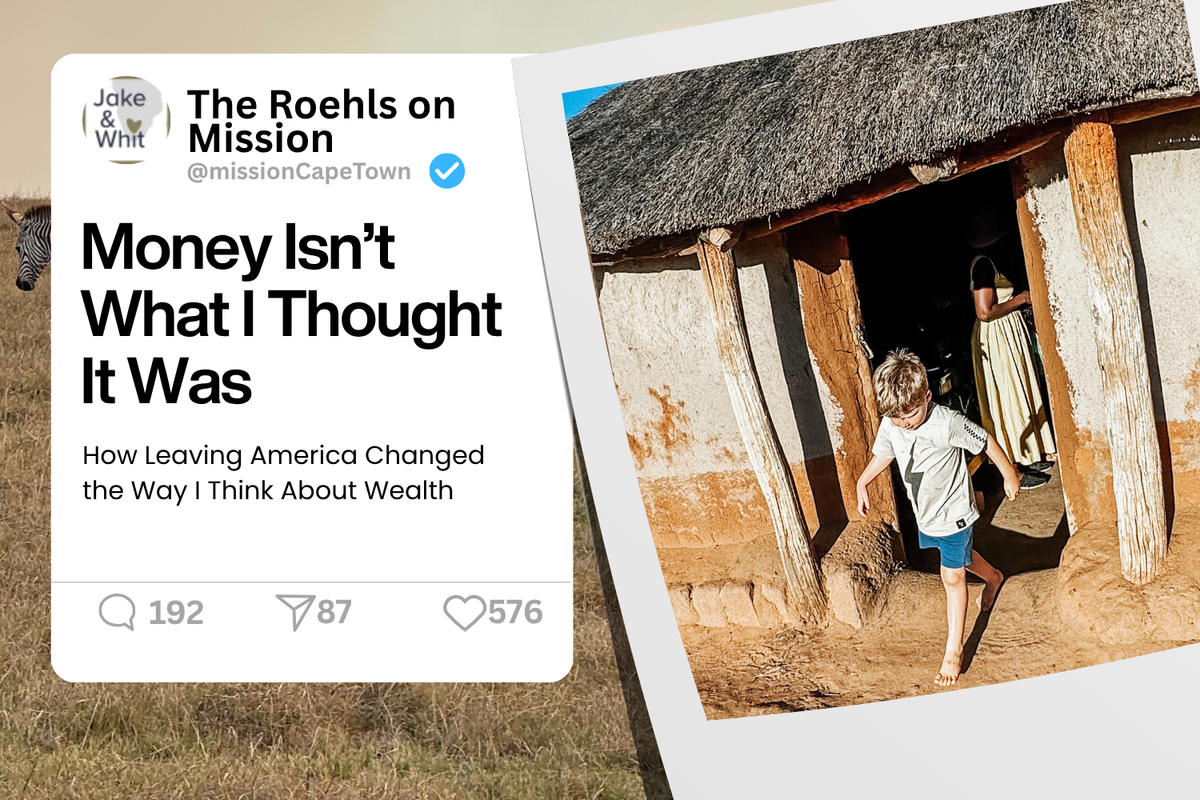
One of the biggest worldview shifts I’ve had from spending time in Zimbabwe and South Africa is realizing how much faith I accidentally had in money.
Not because I consciously worshipped it. More because, as an American, money always works.
If you have money, you can solve problems.
Need food? Buy it.
Need transportation? Pay for it.
Need safety? Move.
Need healthcare? There’s a system for that.
Money feels almost magical because the infrastructure around it is so dependable.
Then you spend time somewhere where the systems underneath the money are fragile, and suddenly you realize money itself is not actually the thing holding life together.
One moment that stuck with me happened in a Khoisan village. A woman had been given R200, which in my American brain immediately translated to “helpful.”
But then I realized she had roughly a 28-kilometer round trip on foot just to get to the equivalent of a tiny convenience store.
Suddenly the money felt different.
Not fake… just incomplete.
Another thing that kept messing with my brain was how shops handled U.S. dollars versus rand. The exchange rate for most of our trip should’ve been somewhere around 16 rand to 1 dollar.
The shops didn’t care.
“One dollar or twenty rand.”
That was the agreement.
The global markets didn’t matter. The local reality did.
Then there was the moment a shop owner refused one of our $20 bills because it had a faint mark on it. I remember feeling confused because, in my mind, the value wasn’t the paper itself. The value was what the paper represented.
But standing there, I realized she understood something I didn’t.
In America, damaged bills get replaced all the time. There are systems constantly refreshing and protecting the currency supply.
In her world, what physically existed in her hand mattered. If the bill became too damaged, the value could disappear with it.
You didn’t just protect money from theft.
You protected it from decay.
Honestly, it made Jesus’ words about “moth and rust” feel less poetic and more practical.
One of the conversations I can’t stop thinking about happened with Teacher while discussing workers for the farm project. He explained that for the first few months they would have to pay the workers in cash, but after the crops came up, they could pay them in food.
And he said that second part with excitement.
It hit me that cash was almost the temporary inconvenience. Food was the real payment.
Cash was just the extra step required to eventually reach something valuable.
Even when we helped fund the well project, I realized how American my assumptions were. In my mind it was simple:
Send money.
Receive money.
Build well.
Except there were still huge logistical challenges just to retrieve money that had technically already been sent.
At one point it required enough travel that it involved an overnight stay.
I think what all of this is doing in me is helping me understand something Jesus was trying to teach that was hard for me to truly feel while growing up inside stable Western systems.
Money is powerful, but it is not the foundation.
Its value depends on thousands of moving parts continuing to function:
infrastructure, transportation, supply chains, agreements, banks, governments, trust, people.
Take enough of those away and you realize something uncomfortable:
you could technically have money and still starve.
The cool part is - that makes it easier for me to understand another layer into Jesus telling me to trust Him instead of wealth. Because I've been deceived about its strength. Money is fragile - Jesus is resilient.